
Cantonal hazard analysis and contingency planning
Providing a basis for concrete work at the cantonal level
Responsibility for handling disasters and emergencies lies mainly with the cantons. The federal government regulates basic aspects of civil protection and ensures the necessary coordination. In accordance with Article 13 of the Federal Act on Civil Protection and Civil Defence (CPDA), the Confederation, in cooperation with the cantons, is responsible for research and development in the field of civil protection, particularly in the areas of risk analysis and disaster and emergency management.
A hazard analysis is necessary to identify risks and, in particular, to plan preparedness measures.
The FOCP provides cantonal authorities with the KATAPLAN guidelines – Cantonal hazard analysis and contingency planning (FOCP, 2013), a tool that summarises the principles for carrying out hazard scenario analyses and developing the associated contingency plans.
To ensure that the cantons have access to up-to-date and appropriate information, the 2013 guidelines are being revised, enhanced and updated to suit the current situation.
In the second half of 2025, a survey and in-depth interviews were conducted across the cantons and Liechtenstein. These were used to assess the current state of cantonal hazard scenario analysis and contingency planning, and to establish what action was required in relation to revising the guidelines. The results are outlined in the report Third survey on implementation status in the cantons and the Principality of Liechtenstein.
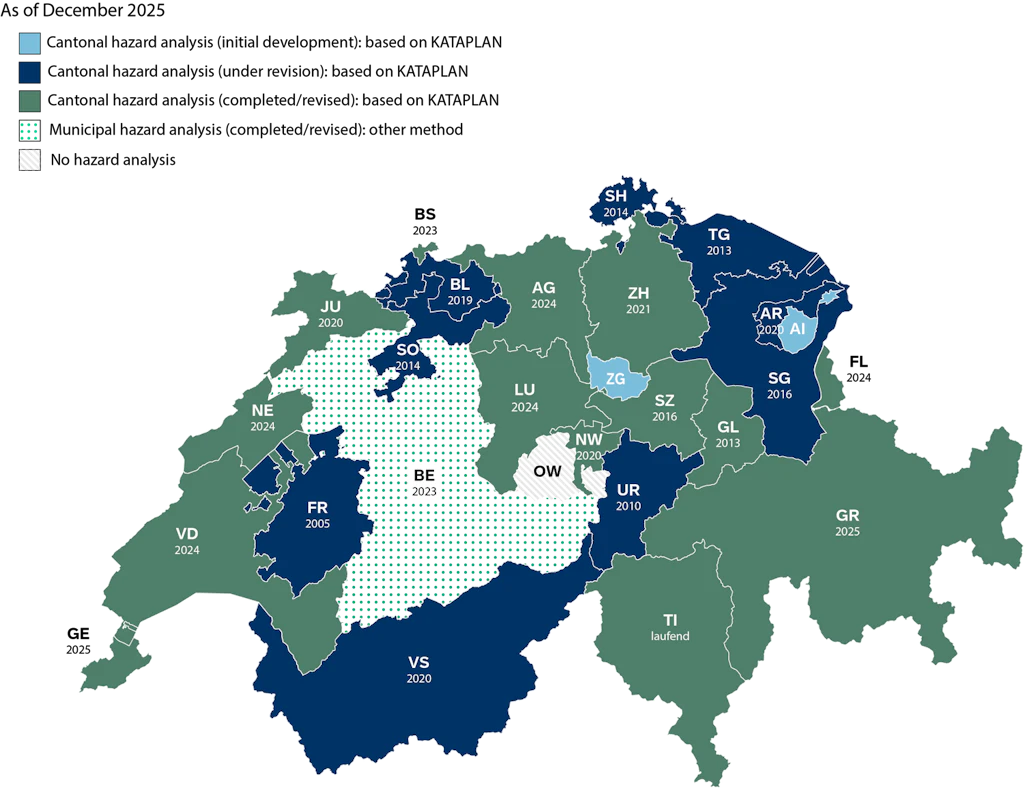
The figure below provides an overview of progress across the cantons and Liechtenstein in implementing hazard scenario analyses.
Target audience and purpose
The KATAPLAN guidelines are designed for cantonal civil protection experts who are involved in hazard analysis and disaster and emergency preparedness.
The guidelines aim to ensure that disasters and emergencies can be adequately planned for and managed in an intercantonal network. This is only possible if there is a standardised process for analysing hazards and the resulting risks. KATAPLAN is based on the core principle of integrated risk management in civil protection.
Hazard analysis communication
Information on hazard analyses is important for raising risk awareness among the population. Those responsible should avoid making abstract statements or alarming the public. Instead, what is needed is a clear and straightforward presentation of existing hazards, how the canton is preparing for them and where the public can find information on protecting themselves.
To this end, the FOCP has developed a guide containing practical advice and measures for planning and implementing hazard analysis communication.
Index
Understanding hazards and risks in civil protection
The growing number of events with a negative impact on people, animals and the environment demonstrates the importance of understanding current and future hazards and their risks.
Integrated risk management in civil protection
Integrated risk management (IRM) plays a central role in responding to disasters and emergencies in Switzerland.
National risk analysis: Disasters and Emergencies in Switzerland (DES)
The main objective of the national risk analysis, Disasters and Emergencies in Switzerland (DES), is to provide organisations that are strategically or operationally responsible for managing disasters and emergencies with risk-based priorities in planning.