
Risk matrix and hazard files
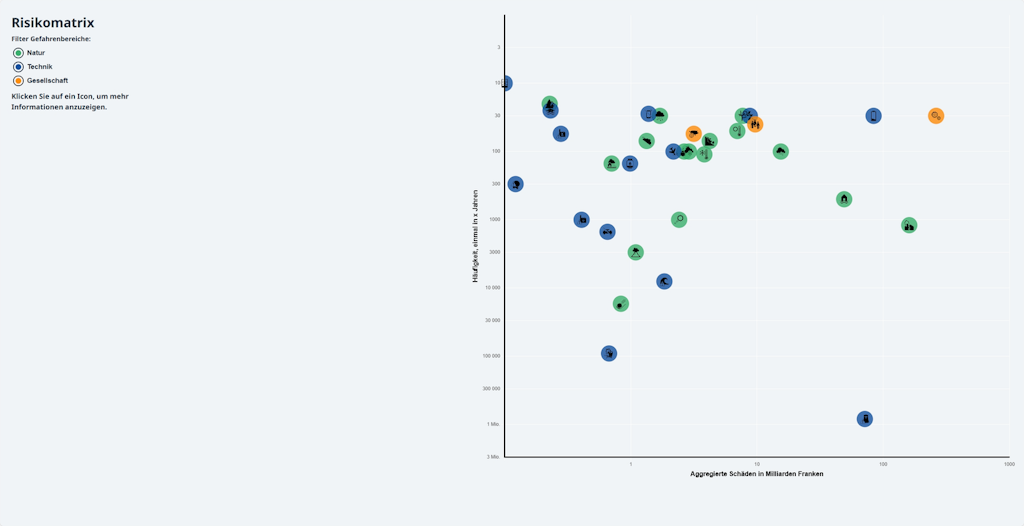
The following risk matrix shows all non-malicious hazards. It is based on the expected frequency of occurrence (once in X years) and the estimated total damage (in billions of Swiss francs) of the ‘major-intensity’ scenarios described in the file. The further to the right a scenario appears in the matrix, the greater the expected damage. The further up the matrix a scenario appears, the higher the likelihood of its occurrence. Therefore, the further up and to the right a scenario appears, the greater the risk.
Interactive risk matrix for non-malicious hazards
The following risk matrix shows all non-malicious hazards. It is based on the expected frequency of occurrence (once in X years) and the estimated total damage (in billions of Swiss francs) of the ‘major-intensity’ scenarios described in the file. The further to the right a scenario appears in the matrix, the greater the expected damage. The further up the matrix a scenario appears, the higher the likelihood of its occurrence. Therefore, the further up and to the right a scenario appears, the greater the risk.
Clicking on a symbol opens a window containing a brief description of the scenario and a link to the relevant hazard file.
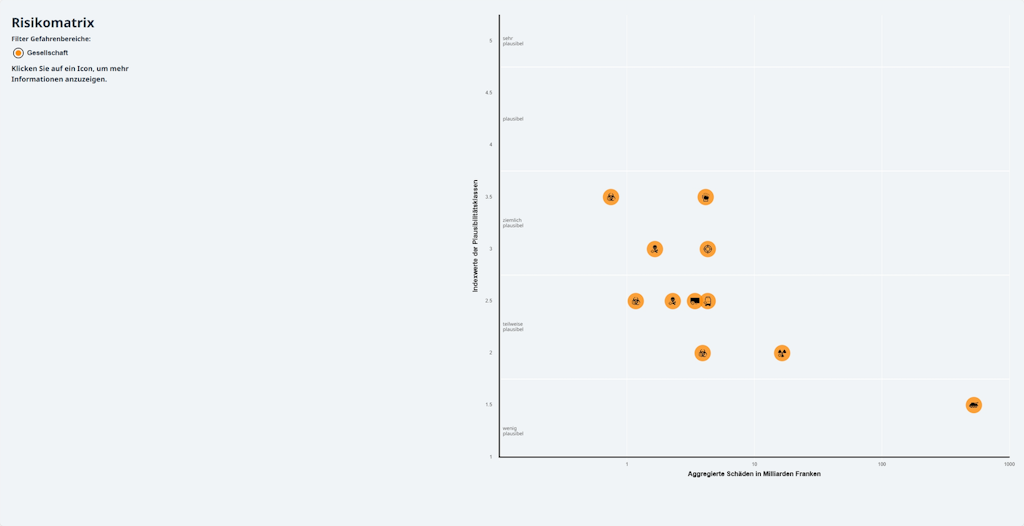
Interactive risk matrix for malicious hazards
The following risk matrix shows all malicious hazards. It is based on expected plausibility (index) and the estimated total damage (in billions of Swiss francs) of the ‘major-intensity’ scenarios described in the file. The further up and to the right a scenario appears in the matrix, the greater the plausibility of its occurrence and expected damage.
Clicking on a symbol opens a window containing a brief description of the scenario and a link to the relevant hazard file.
Hazard files
The FOCP's latest national risk analysis (Disasters and Emergencies in Switzerland (DES) 2025), contains 44 hazard files and corresponding scenarios. For the purpose of comparability, each file describes a hazard according to a systematic structure including the following: definition of the hazard, examples of occurrence, influencing factors, scenario intensity, scenario, impacts, risk matrix, relevant legislation and additional information.
Each file focuses on a systematically developed scenario that describes the possible sequence of events. Where possible, the scenarios are based on real occurrences and also take future developments into account. The descriptions focus on the negative impacts anticipated under and directly attributable to the event.
Data related to the national risk analysis, Disasters and Emergencies in Switzerland (DES 2025)
The data of the national risk analysis, Disasters and Emergencies in Switzerland (DES 2025) are available in German as an Excel spreadsheet. You can order the document by entering the required information below and clicking on ‘Send’. The list will be sent to you by email.