

Interaction between hazards
Hazards rarely occur in isolation. Events often interact with each other: one event can trigger another, exacerbate existing risks or set off a chain of further hazardous events. This interaction can lead to a significantly greater impact than initially expected.
There are various types of hazard interaction:
- Triggering interaction: An event triggers one or more other hazards. These triggered hazards then set off further hazards. For example, a windstorm can cause an electric power supply outage, leading to mobile network failure.
- Amplifying interaction: A hazard increases the likelihood and/or severity of future hazards. For example, drought increases the likelihood of forest fires.
- Compound interaction: Two or more hazards occur simultaneously or in close succession, affecting the same region. These hazards can also occur independently, i.e. without a causal link. Examples include an electric power supply outage coinciding with an extreme cold spell, an earthquake occurring during a pandemic, or a windstorm causing major damage during an armed conflict.
These three types of interaction can also occur in combination, leading to complex, multi-hazard situations.
The interactive graphic illustrates the possible interactions between the 44 hazards identified by DES 2025. It focuses on the first two types – triggering and amplifying interactions. These are shown together in the graphic. The third type – compound interaction – has not been included, as the possible combinations can affect all hazards.
The graphic thus shows for each hazard (a) the possible triggers and amplifiers of the hazard and (b) the possible subsequent events and amplifying effects triggered by the hazard. The thicker the line between hazards, the stronger the interaction. The larger the circle, the greater the impact of the hazard, i.e. it triggers more hazards or amplifies them. More information and a detailed overview of the interactions can be found in the national risk analysis report.
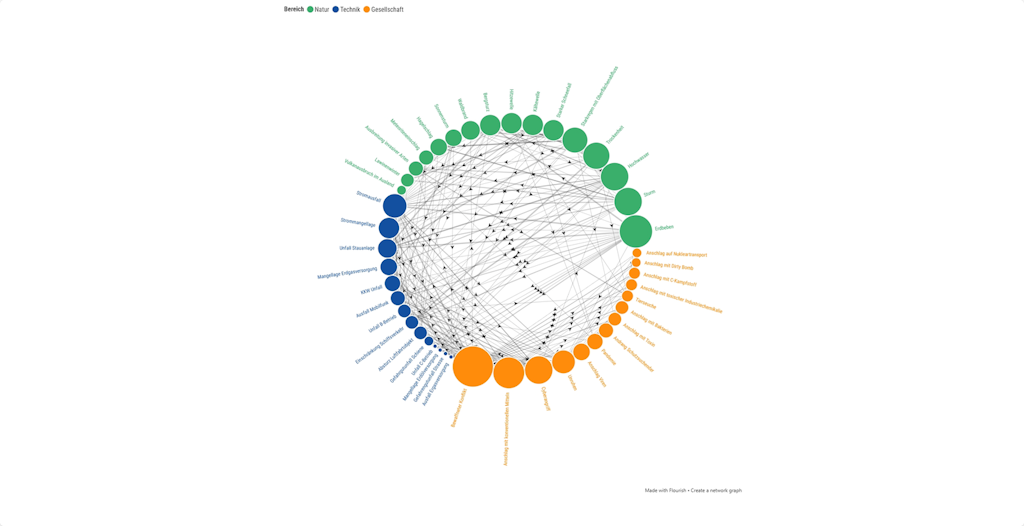
Reading the graphic:
- Earthquakes: Earthquakes can trigger or exacerbate many other hazards, especially in the area of technical hazards. Earthquakes, however, can also be triggered by a meteor strike.
- Drought: Heat waves are a powerful driver of evaporation. When combined with a lack of precipitation, this can lead to a water deficit, which can develop into a severe drought over longer periods of time. At the same time, drought exacerbates other risks, such as the likelihood of forest fires.
- Electric power supply outage: Electric power supply outages can have various causes. They can be triggered by windstorms, earthquakes or even cyberattacks. In turn, they can trigger further hazards, such as mobile network failure.