New Generation Information and Application System (IES NG)
Background and aims of the project
Vision
The IES NG enables command and emergency services to optimise patient tracking during medical incidents such as accidents, major incidents and disasters. The aim is to improve the quality of care by providing up-to-date overviews of the medical situation, to allocate patients to hospitals and to enable the exchange information between the emergency services and the cantonal, federal and third-party command and emergency services.
Incident management support
The software is designed to help answer the following questions in particular:
How many casualties are there?
What condition are they in?
Where are the injured?
What dangers are there at the site of the incident?
Which emergency services are available?
Which emergency services can be deployed within a given period of time?
Which partner organisations can be deployed in incident management?
Which hospitals can provide patients with optimum care?
Which hospitals have available capacity to provide optimum care for the injured?
When an incident occurs, a rapid flow of information and clear communication are vital. IES NG provides an efficient basis for networked information and resource management. Rescue, security and command organisations as well as hospitals can use the software to provide the best possible care for all patients and thus facilitate incident management in the medical services throughout Switzerland.
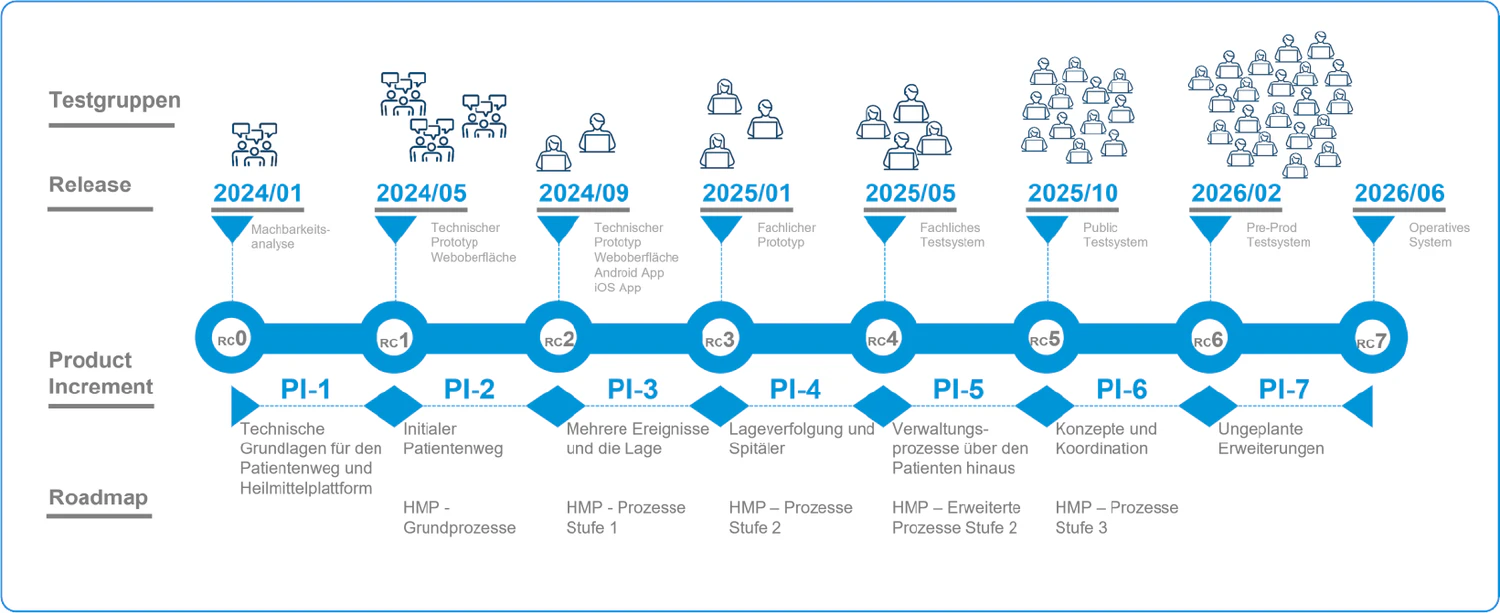
Project roadmap
Online digital workshop events
During development, a series of online events will be held to allow members of the profession-specific ‹pools› a regular look at our digital workshop – so sign up in your pool now. In these online events it is explained which functions have already been implemented, what they look like and what will be developed next. Your feedback on the specific functions and their quality will help us to keep on improving the software in an agile development process.
The third development stage (PI-3) of the IES NG project has been completed. The work is on schedule. The processes along the patient pathway – from pre-triage via triage and treatment through to transport capacities, transport management and transport – have largely been implemented and will be tested along with specialist staff by the end of January.
In the next phase (PI-4), the focus is on technical topics. We are working with the CMS, H+ and selected hospitals to prepare the development of specialised functions for the hospitals. In the first quarter of 2025, we will also be setting up the Therapeutic Products Platform module, which will be put into operation on 1 July 2025.
Cooperation with our partners organisations IVR (Swiss Rescue Association), SGNOR (Swiss Society of Emergency and Rescue Medicine) and the Swiss Paramedic Association has begun, and initial meetings have taken place to validate the technical functions. This cooperation will be intensified in PI-4.
The new IES NG system technical prototype RC3 (successor to the CMS information and deployment system) was tested on 23 January 2025 at the Bünda medical aid station in Davos during the WEF 2025 Annual Meeting. An exercise involving a mass casualty incident took place as part of the deployment of the Swiss Armed Forces medical corps and medical unit along with several civilian rescue services. Such exercises are carried out annually and cover the entire patient pathway, from pre-triage to the patient being transported from the medical point.
During the exercise on 23 January, the new IES NG system alone was used to document events, and its suitability for use in an actual incident was tested. The feedback from the exercise participants was extremely positive, in particular regarding the system’s clear and intuitive operability, its proximity to the Swiss patient routing system (PLS Schweiz) and its user-friendliness. The IES NG system could be used by all participants without any training and without delaying or disrupting the course of treatment. The development team accompanied the exercise and was able to gain important technical and medical insights for use in further developments.
The second development phase of the information and deployment system (IES NG) project was successfully completed on 16 September 2024. The resulting prototype includes the option of recording patients and displaying their names in a patient overview. It was presented at the annual event of the Coordinated Medical Service (CMS) and at the first online digital workshop event.